Sub-Zero not making ice? A Pleasanton hard-water guide
Why a Sub-Zero ice maker stops or slows in Pleasanton — frozen fill tubes, scaled inlet valves, the optical sensor and the clear-ice cycle — plus what hard Tri-Valley water has to do with it.
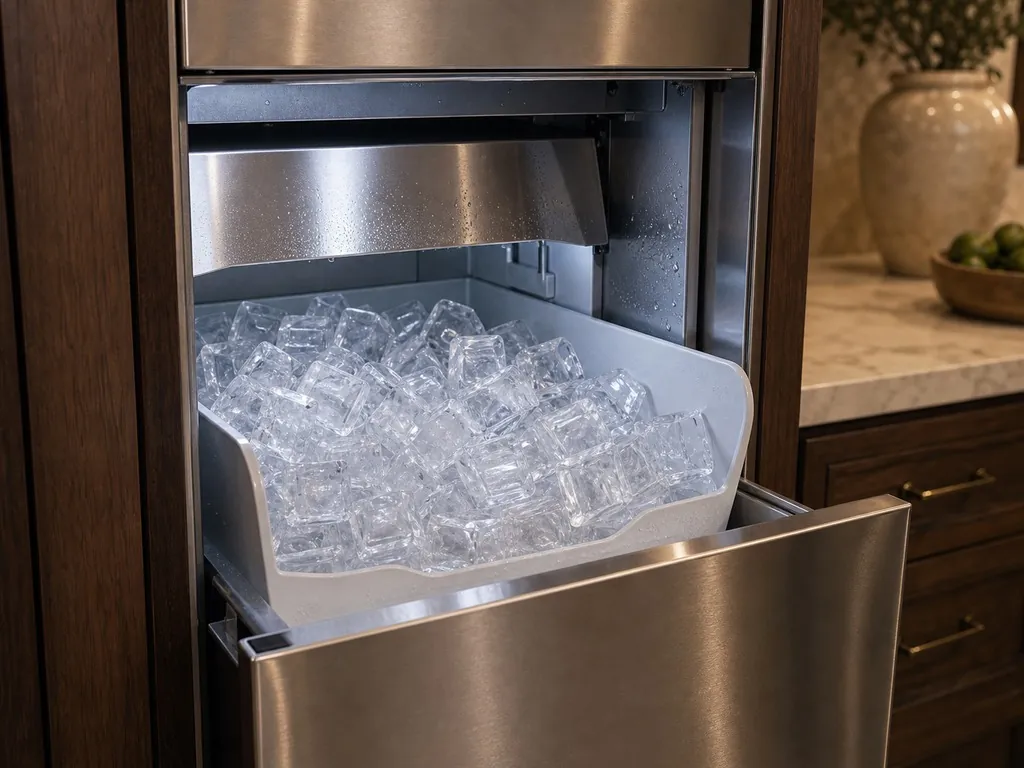
An ice maker is the appliance you ignore until the bin runs empty before a Saturday dinner. On a built-in Sub-Zero in Pleasanton, a sudden drop in production is rarely random — and surprisingly often it traces back to something local: the water itself. The Tri-Valley runs on relatively hard water, and that mineral content quietly works against the small, precise parts that make ice.
Before you assume the worst, it helps to know how a Sub-Zero actually makes ice and where the process tends to stall. Most no-ice and low-ice calls we run across Ruby Hill, Vintage Hills and Birdland end in one of a handful of small, fixable parts rather than anything dramatic. Here is how an independent specialist works through it.
How a Sub-Zero makes ice — and where it stalls
A built-in Sub-Zero ice maker is a small assembly line. Water travels from your household line through a saddle or shut-off valve, through an electrically operated inlet valve, up a thin fill tube, and into a mold. The mold freezes the water, a sensor or thermostat decides the cubes are ready, a module ejects them, and the cycle repeats. A clear-ice unit adds a refinement — it freezes water slowly in a way that pushes out trapped air for that crystal-clear cube, which means it is even more sensitive to flow and timing.
Because it is a sequence, ice production stops wherever the weakest link gives out. No water reaching the mold means a closed valve or a frozen fill tube. Water arriving but no cubes ejecting means the module or its sensor. Cubes that are small, hollow or cloudy point to flow or a partially restricted line. Knowing which stage failed is what turns a guessing game into a single-part repair.
Why hard Tri-Valley water is the local culprit
Here is the Pleasanton-specific part. The water serving the Tri-Valley carries enough dissolved mineral content that scale builds up over time on exactly the surfaces an ice maker depends on. Inside a thin fill tube, that scale narrows the passage and gives water a place to cling and refreeze, so the tube ices shut and starves the mold. On an inlet valve, scale collects on the seat so the valve cannot close fully — which weeps water, or holds it open just enough to disrupt the fill volume.
The pattern we see is gradual decline rather than a sudden death: the bin takes longer to fill, then cubes get smaller, then production stops. That slow fade is the fingerprint of scale rather than a failed electrical part. When we replace a scaled fill tube or inlet valve, we use genuine OEM components and check the supply line and pressure, because fitting a new part onto a neglected, high-scale supply only restarts the same clock.
Quick checks before you call — and when to stop
A few things are worth checking yourself. Confirm the ice maker is actually switched on — it is easy to bump the arm or the on-screen toggle. Make sure the shut-off valve under the sink or in the basement is fully open and the line is not kinked. If the unit was recently moved for cleaning, check that nothing pinched the supply line behind it. And give a freshly serviced or freshly refilled unit a full day; a clear-ice cycle is slow by design, and a single empty bin is not yet a fault.
Stop at the point where tools or disassembly come in. Thawing a fill tube with anything sharp risks puncturing it, and probing the valve or module without testing the circuit usually replaces the wrong part. If water is not reaching the mold, if cubes will not eject, or if production has faded over weeks, that is the moment a specialist with a meter saves you money — and it is firmly a repair, not a self-fix.
Repair, not replace — and where it connects
Almost every Sub-Zero ice problem is a component-level repair. A fill tube, an inlet valve, a module or an optical sensor is modest next to the value of the built-in itself, and replacing the whole appliance over an ice maker is rarely the right call. We diagnose the stage that failed, fit the genuine OEM part, clear and pressure-check the line, and verify a full, clean ice cycle before leaving — with the diagnostic waived once you approve the repair and a year on the labor.
This guide is the why; the booking and the full scope live on our ice maker and water line service page, which covers leaks, cloudy ice and clogged lines as well as no production. If your unit is also pooling water on the floor, that overlaps with our Sub-Zero leaking water page, since a split fill tube can cause both at once. To get on the schedule, call or book online — phone and online booking only, no forms or email.
Repair guide FAQ — Pleasanton
Why did my Sub-Zero ice maker slowly stop making ice?
A gradual fade — slower fills, then smaller cubes, then nothing — is the classic sign of mineral scale from hard Tri-Valley water narrowing a fill tube or fouling the inlet valve seat. We replace the scaled part with a genuine OEM component and check the supply line so the problem does not simply return.
Is low or no ice ever a sign of a bigger refrigeration problem?
Occasionally. If the whole freezer is also warm, the ice maker is just the first thing you noticed and the real issue is a freezer or sealed-system fault. We confirm the freezer is holding a true hard freeze before treating it as an ice-maker-only repair.
Can I thaw a frozen fill tube myself?
It is best not to. A fill tube is thin and easy to puncture, and a leak there turns a simple thaw into a parts repair. If the tube has frozen shut once it will usually refreeze unless the underlying flow or scale issue is fixed, which is the part worth leaving to a specialist.
How do I book Sub-Zero ice maker repair in Pleasanton?
Call us or book online — those are the only two ways we take work, with no contact forms or email. Have your model and serial from the door jamb ready, plus your neighborhood, so the right inlet valve, fill tube or module rides along on the first visit.
Rather have a Pleasanton specialist handle it?
Speak with a built-in refrigeration specialist now, or book online in under a minute. $89 service call, waived with repair, and 365-day warranty on all labor.