Sealed system & condenser repair for Tri-Valley estates
Big built-ins, hot inland summers. When a Pleasanton estate Sub-Zero runs hot, short-cycles or drifts warm in July, we diagnose the sealed system with pressure and electrical readings — never a guess — then repair it with genuine OEM parts and a 365-day labor warranty.
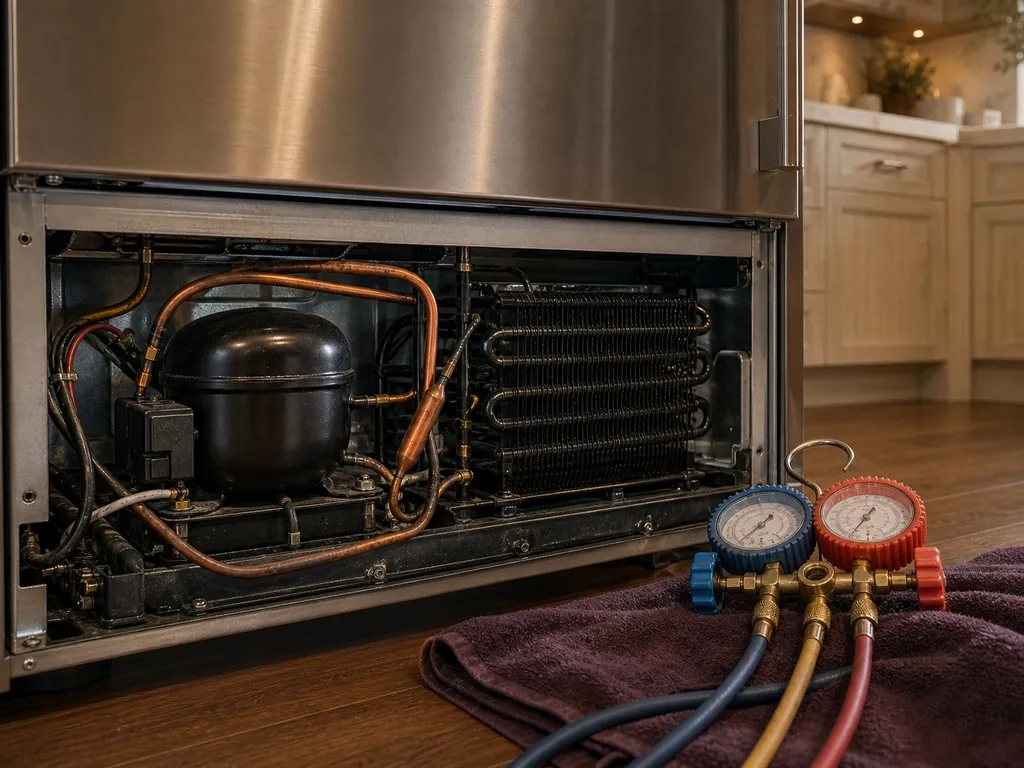
Why Tri-Valley summers stress big built-ins
Pleasanton, Livermore and San Ramon sit inland, away from the coastal marine layer, so summer afternoons routinely run far hotter than they do a few miles west. Estate kitchens in Ruby Hill, Vintage Hills and Kottinger Ranch pair that climate with the largest Sub-Zero platforms — 42- and 48-inch built-ins, PRO 48 units and dual-compressor columns — which already carry heavy condenser load even on a mild day.
Heat is the enemy of a sealed system. A refrigerator works by moving heat out of the cabinet and rejecting it through the condenser; when the room and the air around the unit are hot, the condenser has to work harder to dump that heat. Add a winter and spring of accumulated dust, pet hair or nearby construction grit choking the coil, and the system loses headroom right when it needs it most. The result is the classic Tri-Valley complaint: a built-in that held fine all year suddenly runs constantly and drifts warm during the first real heat wave.
The good news is that the fix is usually far smaller than homeowners fear. Before anyone talks about a compressor, the honest first questions are: is the condenser clean, is the fan moving air, and does the charge hold pressure? That is why every call here starts with cleaning and measurement, not parts. For a broader walkthrough of warm-cabinet symptoms, see our not-cooling diagnostics page, and for the full lineup of platforms we service, the Sub-Zero repair hub.
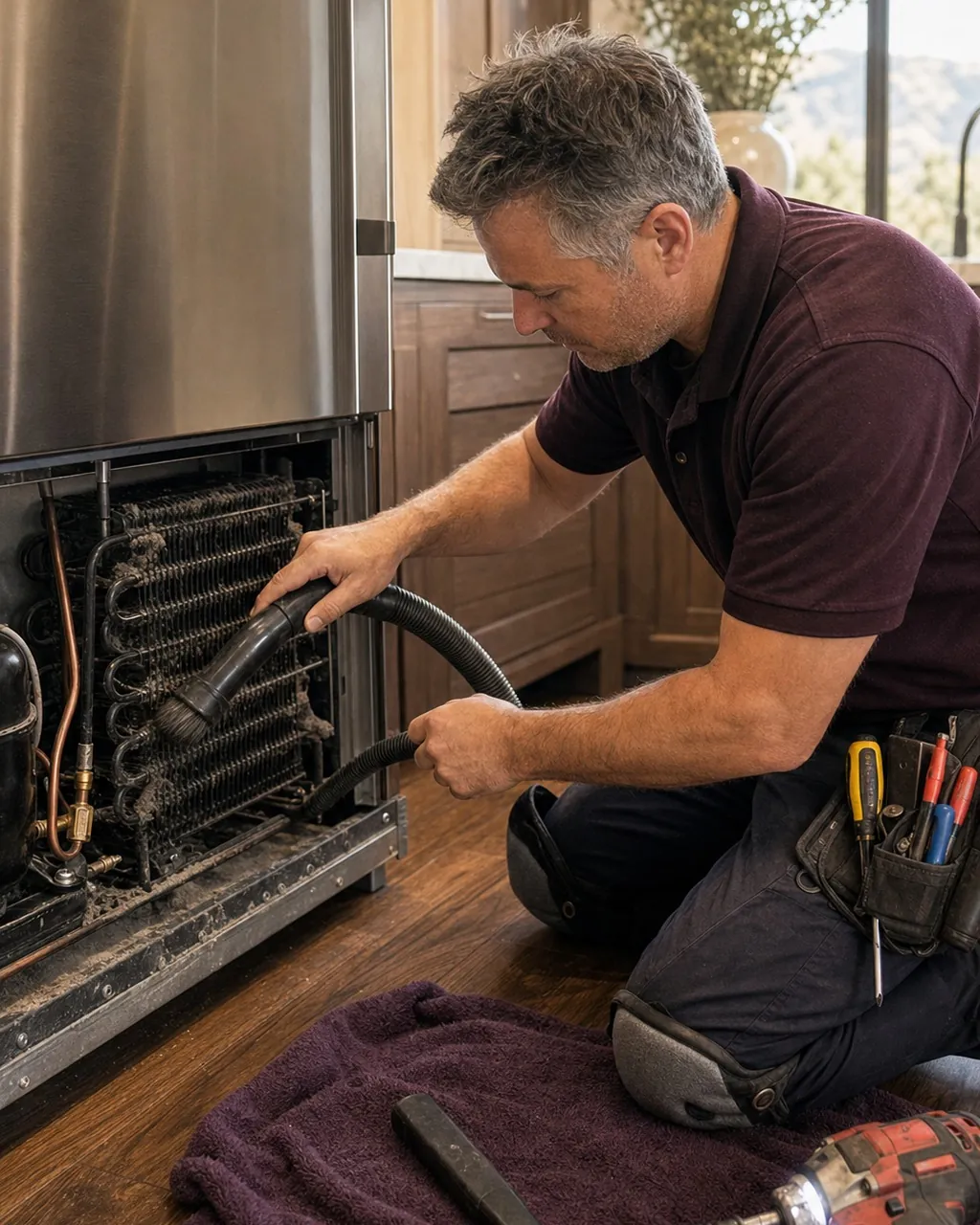
A clean condenser is the cheapest insurance in summer
On a built-in Sub-Zero, the condenser lives in the lower mechanical bay behind the grille, and on a tall estate column it can be surprisingly easy to overlook. In dusty, hot Tri-Valley conditions that coil packs with debris far faster than a coastal home — and a packed coil is the most common reason a healthy unit starts running hot in July.
We treat the condenser as the first suspect, not an afterthought. A thorough cleaning often restores full performance on its own, which means no sealed-system work and a fraction of the cost. When cleaning alone is not enough, the post-clean readings tell us exactly what to look at next — a tired fan motor, a marginal charge or, rarely, the compressor itself.
- Deep coil cleaning. We vacuum and brush the full condenser, not just the visible face, so the coil can shed heat under peak inland load.
- Fan & airflow check. A slow or seized condenser fan traps heat in the lower bay; we verify amp draw and bearing drag before replacing it.
- Pull-down retest. After cleaning we rerun the unit and watch whether temperatures recover, confirming the fix held before we leave.
What your built-in is telling you
These are the sealed-system and condenser symptoms we see most across Pleasanton and the wider Tri-Valley. Note the pattern in the right column: in every case the action begins with measurement, because naming an expensive part without evidence is exactly what we refuse to do.
| Symptom | Likely cause | What we do |
|---|---|---|
| Both compartments slowly drifting warm in summer | Dust-loaded condenser shedding heat poorly under inland load | Deep-clean the condenser, recheck pull-down, confirm pressures recover |
| Compressor runs nonstop yet never reaches set point | Low or restricted refrigerant charge, or a weakening compressor | Take suction/discharge pressures and amp draw before quoting any sealed-system work |
| Short-cycling — clicks on, runs briefly, clicks off | Failing start relay, start capacitor or overload on the compressor | Test start components electrically; replace the failed part, not the whole system |
| Lower mechanical bay hot to the touch, fan barely moving | Seized or slow condenser fan motor leaving heat trapped | Verify fan amperage and bearing drag, install genuine OEM fan motor |
| Frost or oily film on a sealed-system line | Partial restriction or a moisture-laden filter-drier | Confirm the restriction by pressure/temperature, replace drier, evacuate and recharge to spec |
| Unit recovered after a heat wave but struggles every July | Marginal charge plus chronic condenser load on a large built-in | Document readings across the cycle; recommend cleaning, charge or compressor honestly |
If your unit is warm but the symptom does not look sealed-system related — a single warm compartment, frost on the back wall, or an ice-maker leak — start with built-in refrigeration repair or the ice maker & water line page instead. Two close cousins share this dust-and-condenser story: the vacuum-condenser light is the unit asking for the same coil cleaning, and a condenser-fan buzz is often that same dust loading the fan.
What not to do when a built-in is running hot
A few well-meant moves turn a manageable sealed-system problem into an expensive one. While you wait for a Tri-Valley specialist:
- Don’t crank the thermostat colder. A struggling condenser or low charge cannot cool faster on command — you only make the compressor run harder and hotter in the inland heat.
- Don’t keep power-cycling the unit. Repeatedly unplugging a hot compressor to “reset” it can damage start components and mask the readings we need to diagnose the fault.
- Don’t run a built-in with a silent or screeching fan. A seized condenser fan bakes the lower bay and can push a marginal compressor over the edge — shut the unit down and call.
- Don’t let anyone add refrigerant “to top it off.” Sub-Zero systems are sealed for a reason; a blind recharge without pressure readings hides the real fault and can contaminate the system.
- Don’t wait days in a heat wave with food at risk. Move perishables to a cooler, then book — no-cooling and food-at-risk calls get priority on our route.
How we diagnose a sealed system in the Tri-Valley
- 01
Call or book with model in hand
Reach a Pleasanton sealed-system specialist by phone or book online. Share the Sub-Zero model and serial and what you see — running hot, short-cycling or warm in summer — so we arrive with the right gauges and OEM parts.
- 02
Take pressure & electrical readings
Before any expensive part is named, we connect manifold gauges and a meter: suction and discharge pressures, compressor amp draw, start-component and fan-motor values. The numbers, not a guess, tell us whether the fault is the condenser, the charge or the compressor.
- 03
Clean, prove, then repair to spec
We deep-clean the condenser, retest pull-down, and confirm whether pressures recover. Only if the readings still prove a restriction or failed compressor do we replace the drier, recharge, or change start components with genuine OEM parts to Sub-Zero specifications.
- 04
Verify cold & back it 365 days
We run the unit through a full cycle, confirm both compartments hold temperature under load, and tidy the mechanical bay. The $89 service call is waived with the repair, and every bit of labor is backed by a 365-day written warranty.

Pressure and electrical readings — then the recommendation
Sealed-system and compressor work is the single most expensive repair a Sub-Zero can need, which is precisely why we will not quote it on a hunch. We connect a manifold gauge set and a meter and document the system's actual behavior: how it pulls down, what the pressures read, how many amps the compressor draws under load, and whether the start components are healthy.
Those readings tell a clear story. A clean condenser with normal pressures and a marginal charge points one direction; pressures that never recover, or a compressor drawing locked-rotor amps, point another. Either way, you get the evidence behind the recommendation — and you approve a firm written quote before we open the sealed system. It is the same disciplined approach we bring to not-cooling calls, and it is why estate owners across Livermore and San Ramon trust us with their most expensive built-ins.
- Real numbers, written down. Suction and discharge pressures and compressor amp draw — the readings that distinguish a charge issue from a failed compressor.
- Start-component testing. Relays, start capacitors and overloads are tested electrically; a failed start part is a small fix, not a sealed-system job.
- Honest repair-vs-replace. On an older estate unit we show you the math so you can decide with the evidence in front of you.
Sealed-system & condenser repair price ranges
Use these to plan; your firm quote follows the on-site pressure and electrical diagnosis, with the $89 service call waived once you book the repair.
$89 service call, waived with repair
365-day warranty on all labor
We install genuine OEM Sub-Zero parts
| Service in Pleasanton | Planning range | Time | Notes |
|---|---|---|---|
| Diagnostic / service call | $89 | 45–90 min | Model, temps, airflow & visual checks ($89 portion waived with repair) |
| Door gasket / frost-line | $400–$900 | 1–3 h | Model & gasket availability |
| Ice maker / water line | $275–$850 | 1–3 h | Valve, fill tube or module |
| Control board / sensor | $350–$1,250 | 1–4 h | Quote after electrical proof |
| Wine column / cooling zone | $300–$1,400 | 1–4 h | Zone sensor, fan, seal, thermostat |
| Compressor / sealed system | $1,450–$3,600 | 2–6 h + parts | Requires pressure / electrical evidence |
Draft ranges for planning; final quote depends on model, parts, access and diagnosis.
Sealed-system repairs across the Tri-Valley
Condenser, charge and compressor outcomes from Ruby Hill estates to Livermore — all diagnosed with readings before parts.
GE Monogram built-in in Livermore was struggling in the heat. They cleaned a heavily dust-loaded condenser, checked the compressor under load, and it has run cold since. Genuine OEM fan motor and a written 365-day labor warranty.
Panel-ready wine column needed to come out of a tight cabinet cutout. They used a dolly, tape and blankets so nothing was scratched — true cabinet-safe work. Sealed-system diagnosis was thorough and the labor is warrantied for a year.
Unit was short-cycling and the compressor felt hot. Instead of pushing an instant compressor replacement, they took pressure and electrical readings first to prove the diagnosis. That kind of evidence-based approach earned my trust — and the warranty is real.
Sealed system & condenser FAQ — Tri-Valley
Why does my Sub-Zero run hot or struggle during Tri-Valley summers?
Inland Pleasanton, Livermore and San Ramon summers push large built-ins far harder than coastal climates. A condenser caked with dust cannot shed heat, so the compressor runs longer and both compartments drift warm on the hottest afternoons. Often a deep condenser cleaning restores performance; we confirm with pressure readings before recommending anything bigger.
Do I really need a new compressor if my built-in is warm in summer?
Usually not. Most "warm in summer" estate calls trace to a dirty condenser, a slow fan motor, a marginal refrigerant charge or a tired start relay — all far cheaper than a compressor. We take suction and discharge pressures and compressor amp draw first, so a compressor is only recommended when the electrical and pressure evidence actually proves it has failed.
What does evidence-based sealed-system diagnosis mean here?
It means we attach manifold gauges and a meter and write down real numbers — pressures, amp draw, start-component and fan values — before naming any part. Sealed-system and compressor work is the most expensive repair on a Sub-Zero, so we never quote it on a hunch. You see the readings that justify the recommendation.
How often should an estate built-in condenser be cleaned in Pleasanton?
In dusty, hot Tri-Valley conditions we suggest cleaning the condenser at least once a year, ideally before summer. Ruby Hill and Vintage Hills estates with pets or nearby construction load up faster. A clean condenser is the single cheapest way to protect the compressor through a Pleasanton heat wave.
My compressor clicks on and off repeatedly — what is that?
Short-cycling on a Sub-Zero usually points to a failing start relay, start capacitor or overload protector rather than the compressor itself. We test those start components electrically; replacing the failed part is a fraction of a sealed-system job. We only escalate if the readings show the compressor windings are genuinely bad.
Is it worth repairing the sealed system on an older Ruby Hill built-in?
Often yes. Sub-Zero built-ins are engineered for component-level service, and the cabinet, doors and interior typically outlast the mechanicals. A drier-and-recharge, a start kit or a fan motor frequently costs far less than replacing an integrated estate unit, so we give honest repair-versus-replace math after diagnosis.
What sealed-system and condenser parts do you replace?
Condenser fan motors, filter-driers, start relays, start capacitors, overload protectors, refrigerant charge to factory spec, and — when truly required — the compressor itself. Everything is genuine OEM, installed following Sub-Zero service specifications, which protects both performance and your 365-day labor warranty.
How much does sealed-system or compressor repair cost in the Tri-Valley?
A diagnostic runs $89 and is waived with the repair. A condenser cleaning or fan motor is modest; a full compressor or sealed-system job typically lands $1,450–$3,600 depending on model and parts. You always approve a firm written quote — backed by the pressure and electrical readings — before any sealed-system work begins.

Built-in running hot this summer? Get the evidence-based diagnosis.
Speak with a built-in refrigeration specialist now, or book online in under a minute. $89 service call, waived with repair, and 365-day warranty on all labor.